
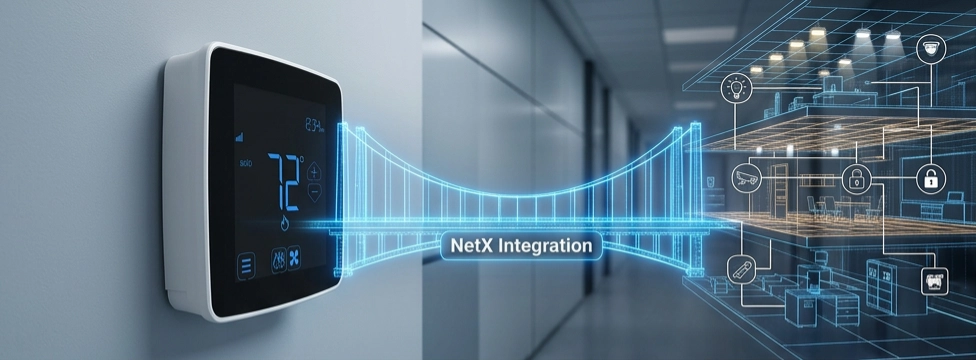
Integrations that bridge the automation gap
NetX helps real buildings do more than a basic thermostat can handle without forcing every project into the cost and complexity of a full Building Automation System. Our integrations are a big part of that difference.
From protocol support and occupancy-driven HVAC to VAV control and automation drivers, NetX gives facility teams, contractors, and integrators practical ways to connect HVAC control to the wider building environment.

Practical integrations for real buildings
A traditional thermostat usually stops at local temperature control. A full Building Automation System can extend much further, but many buildings do not need the full overhead that comes with it.
NetX bridges that middle ground with integration-ready HVAC controls that support commercial building workflows, connectivity requirements, and energy strategies. Whether the goal is better interoperability, better visibility, occupancy-based control, or a simpler path into VAV applications, NetX is built to help organizations add practical automation without overcomplicating the job.
Why integrations matter in the first place
Integrations are what turn a thermostat from an isolated control point into part of a broader operating strategy.
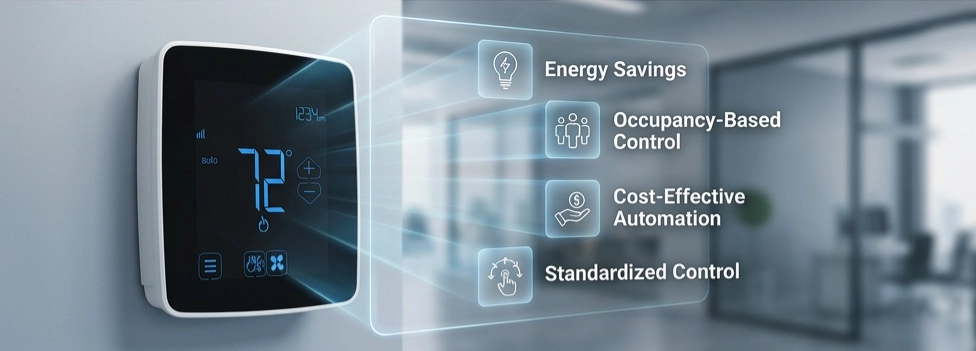
With NetX, integrations help buildings:
- Connect HVAC control to broader building and IT systems
- Use occupancy signals to reduce unnecessary conditioning
- Standardize control across sites and applications
- Extend visibility beyond the wall thermostat
- Support retrofits without forcing a full Building Automation System deployment
- Create a more cost-effective path to practical automation
That is the core of the NetX approach: not integration for its own sake, but integration that solves real operational problems.
The NetX integration ecosystem
NetX integrations can be understood in four practical groups:
Protocols
Support for BACnet/IP, Modbus TCP/IP, SNMP, and API-based connectivity helps NetX fit into broader building controls and enterprise environments. The current public protocols page highlights BACnet/IP and Modbus TCP/IP specifically, including broad object availability and scheduling support.
Network Lighting Control (NLC)
Occupancy data from lighting systems can be used to drive HVAC behavior automatically, helping reduce energy waste in unoccupied spaces without requiring a full Building Management System. NetX’s Network Lighting Control page presents this as a direct bridge between lighting and climate management.
VAV Control
NetX extends thermostat control into VAV applications with a simpler, more retrofit-friendly approach. The VAV page explains how VAV technicians can keep existing VAV boxes in place while adding intelligent zone-level control without proprietary tools or specialized BAS integrations.
Automation Drivers
NetX also supports automation system drivers for platforms such as AMX, Nice (Elan), Control4, RTI, Crestron, Linxura, URC, and Savant, and others.
Remote Sensors
NetX supports up to sixteen remote sensors per thermostat, enabling temperature averaging across multiple zones, auxiliary probe monitoring for supply air, pipe, and refrigeration applications, water leak detection, and the flexibility to place the thermostat itself out of the conditioned space.
VRV/VRF
NetX brings network-level scheduling, setpoint control, and visibility to VRV/VRF systems, giving facility teams a practical way to manage variable refrigerant systems within the same control environment used for the rest of the building.